

Harvey and Six Other Legal AI Platforms: Which Roles They Target and What the Evidence Shows
Harvey says it is built for law firms and in-house legal teams. We list seven legal AI platforms by the roles and tasks they name, and grade each by whether an operator has confirmed using it.
- Platforms compared7
- Operator-confirmed4
- Vendor claims only3
Recent posts
All categories →Newsroom AI Rules Compared: What Nine News Organizations' Published Policies Permit and Prohibit
Newsrooms have published rules for how reporters and editors may use generative AI. This sets out nine of them side by side, from the BBC and WIRED to CBC and a Swiss public broadcaster: whether AI text may be published, what must be disclosed, who signs off, and what is banned, as each organization states it.
 Work & EvidenceFeature
AI-Attributed Job Cuts in 2026: What Challenger Counts, Month by Month, and What the Count Cannot Say
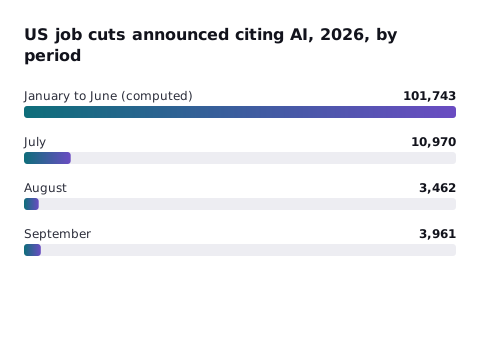
Employers cited AI for 120,136 announced US job cuts in the first nine months of 2026, more than any other reason, but the monthly count fell from 10,970 in July to 3,961 in September. This sets out what the tracker counts, how the reasons were split, the cases where the label is disputed, and what an announced cut does not show.
How Many Teachers Use AI? Seven Surveys Compared, and Why the Numbers Differ
Surveys put US teachers' AI use anywhere from 46% to 85%, and the gap is mostly wording, samples and sponsors. This lists seven surveys with exactly what each asked, whom it asked, who paid, and what it found, and shows why none of the headline figures can be set against another.
 Transport & FieldFeature
How Robotaxi Companies Make Money: Own Fleets, Ride-Hail Partners and Selling the Driver, by the Numbers
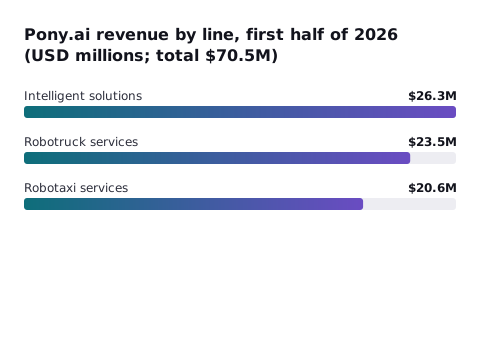
Robotaxi companies earn money in four different ways, and most of them publish few of the numbers. This compares what each model is, who owns the car, who runs the app, and which financial figures Waymo, Pony.ai, WeRide, Baidu, Tesla and Zoox have actually disclosed, with "not disclosed" where that is the finding.
 Transport & Field80 Picks
Robotaxi Services by City and Status: Where Rides Run With No One at the Wheel
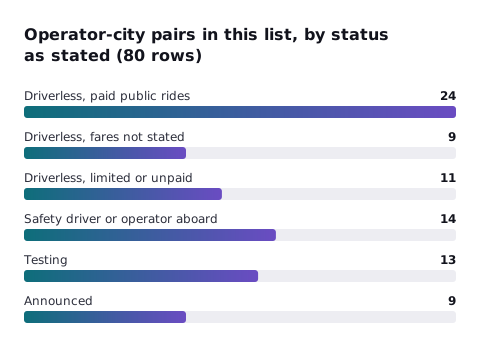
A city-by-city list of 80 operator and city pairs in the US, China, the Middle East, Europe, Singapore, Japan, Korea and Taiwan, each with its status as the operator or regulator states it, from fully driverless paid rides to announced plans, and an evidence grade.
What Banks Say About AI and Job Cuts: Barclays, Standard Chartered, NAB and DBS, Side by Side
Four banks have announced headcount reductions since early 2025, and they describe the role of AI very differently. This sets out what each bank said in its own words, how big the cut is and over what period, and which statements link AI to the cuts and which do not.
 Business & FinanceFeature
Accountants and Auditors: What the Exposure Data and the Jobs Outlook Say, and What the Big Four Report
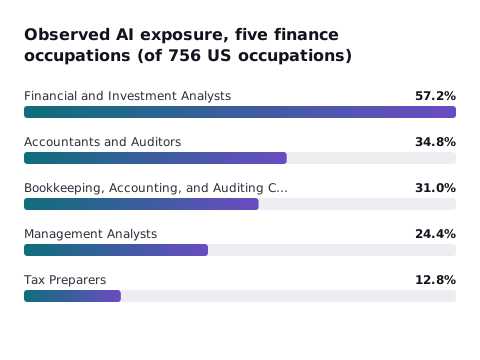
Accountants and auditors rank 49th of 756 US occupations in Anthropic's observed-AI-exposure data, while the Labor Department data on O*NET projects faster-than-average growth to 2035. Here are both, side by side, with what EY, Deloitte and KPMG have said about AI in audit and what the UK regulator expects.
How AI Visual Inspection Works on the Factory Line, and What Inspectors Still Do
Cameras that judge parts and paint finishes are among the longest-running uses of computer vision in factories. This explains how a vision inspection system sees, decides and acts, what BMW and Schneider Electric report, and the steps people still handle.
How AI Agents Triage Security Alerts, and What the First Tests Show
Security teams receive far more alerts than analysts can read, and vendors now sell AI that sorts them. This explains how alert-triage agents are built, what a named operator, a vendor and two research benchmarks each report, and why the evidence still ranges from production to prototype.