Toilet-Cleaning Robots: How Much of a Janitor's Restroom Work They Actually Do
Cleaning restrooms is the janitor's highest-rated task, and robots that clean the toilets themselves have a confirmed record of live work going back only a year. Here is every named toilet-cleaning robot case we could verify, from Hangzhou's public toilets to a Tokyo office pilot, graded by its evidence, with the prices makers publish and the parts of the job cleaners still do.
Role scorecard
Janitors and Cleaners, Except Maids and Housekeeping Cleaners SOC 37-2011.00
- Listed core tasks robots do in production (4 of the role's 12 core tasks have a case)2 of 4
- Most mature evidenceIn production
- Cost$1,500 a month for 8 hours a day on weekdays (Somatic's published price)
- BenefitAbout 3 hours of cleaning cut to about 1.5 at one Hangzhou public toilet (the cleaner's account)
As of · Tasks: O*NET 31.01
| Task (O*NET) | What AI or robots do | Extent | Evidence grade | Example case | Source |
|---|---|---|---|---|---|
| Service, clean, or supply restrooms.Core task, importance 81 (joint highest) | A mobile robot with an arm scrubs, rinses, vacuums, dries and disinfects toilets, squat toilets, urinals and washbasins; the cleaner dispatches jobs, cleans mirrors, walls and windows, and handles blockages. Restocking stays with people. | Does it | In production | Star X2 (Hangzhou Xingwuzhong) at the Tashan public toilet, Yuhang, Hangzhou: a year of daily work alongside one cleaner, reported September 2026; Loki at a Nippon Steel Kowa Real Estate office building (pilot) | 2, 3, 4 |
| Gather and empty trash.Core task, importance 81 (joint highest) | One maker lists picking up trash among its robot's tasks; the same company's CEO said in 2023 that taking the trash out still needed local staff | Not yet | Vendor claim | Somatic's bathroom-cleaning robot ("pick up trash", Somatic's product page) | 15, 16 |
| Clean building floors by sweeping, mopping, scrubbing, or vacuuming.Core task, importance 80 | Autonomous scrubbers clean store and restroom-lobby floors on routes a worker teaches them first; a worker preps the area and starts the run | Does it | In production | Tennant T7AMR scrubbers in every US Sam's Club (2020); Walmart's Auto-C (2018); NEXCO Central's CLINABO in the restroom lobby at Hamamatsu service area (since July 2021) | 20, 21, 9 |
| Clean windows, glass partitions, or mirrors, using soapy water or other cleaners, sponges, or squeegees.Core task, importance 70 | Two makers list mirrors among their restroom robots' targets; in the one production case, the cleaner still does the mirrors | Not yet | Vendor claim | Atomix Robotics POMODO (Korea, 2026); Hivebotics Abluo (Singapore, as described in 2023) | 18, 12 |
Extent and grade follow our evidence grades: "Does it" needs a production case where a robot performs the task without a person doing it in that instance; "Assists" means AI helps a person do it; "Not yet" means only prototypes, vendor claims or nothing. O*NET 31.0 lists 12 core tasks for this occupation; the four rows are the ones for which we found a robot case of any grade. Left out because we found none: monitoring building security, notifying managers of repairs, following procedures for chemicals and power equipment, mixing cleaning solutions, requisitioning supplies, dusting, polishing furniture and fixtures, and moving heavy furniture. The restroom row is "Does it" for toilets and basins only: the Hangzhou cleaner still does the mirrors, walls, windows and blockages, and the reports don't name the organisation that runs the toilet. Both "Does it" rows cover some sites, not the occupation.
Costs and benefits
| Restroom robot subscription (Somatic, US) | "$1,500 / month" for "8 hours / day weekdays", $3,000 for 16 hours on weekdays and $4,500 for 16 hours every day, "hourly $8.63", "deployment included" (Somatic's published prices, retrieved October 18, 2026)15 |
|---|---|
| Price paid by operators | Not disclosed for Star X2, Loki, Abluo or HYTRON; Primech describes HYTRON leases only as "predictable monthly costs"14 |
| Time, Hangzhou public toilet | Work that took "about 3 hours" now takes "about an hour and a half", by the cleaner's account to Hangzhou Daily's news site; not a measured study2 |
| Time, Hivebotics Abluo | "replacing around 30 minutes of manual work with a five-minute human inspection" (investor's release, no site named)11 |
| Time, NEXCO Central floor robot | Total restroom cleaning time expected to fall "about 10%" with a floor robot (operator's expectation at launch, 2021)9 |
| Complaints, usage sensors (Sodexo, Paris) | "up to 90% fewer complaints" after 1,300 Tork Vision Cleaning devices at one headquarters (Sodexo's facilities director, quoted in Tork's release)22 |
| Human wage benchmark | Median $17.71 an hour, $36,840 a year for this occupation in 2025 (Bureau of Labor Statistics data, via O*NET)1 |
Seen at work
As of · Named robot cases in public and commercial restrooms, from operators', makers', researchers' and news outlets' own pages
| Robot | Maker | Operator | Site | What it cleans | Evidence grade | Confirmed by | Scale as stated | Latest source date |
|---|---|---|---|---|---|---|---|---|
| Star X2 | Hangzhou Xingwuzhong Robot | Not named (public toilet) | Tashan public toilet, Yuhang, Hangzhou, China | Fixtures: toilets, urinals, washbasins | In production | Hangzhou Daily's news site, reporting a year of daily work2 | "more than 100" robots in Hangzhou public toilets; about 1,500 ordered by six partners (company figures, as reported)23 | 2026-09-27 |
| CLINABO | Nippon Signal | NEXCO Central (its maintenance subsidiary, Central Nippon Highway Maintenance Tomei) | Hamamatsu service area (down), Shin-Tomei Expressway, Japan | Floors: restroom lobby and aisles, not cubicles | In production | NEXCO Central (operator)9 | One robot, in operation from July 9, 2021 | 2021-06-30 |
| Intelligent Sterilization Robot | Not named | Airport Authority Hong Kong | Hong Kong International Airport terminal | Disinfection: air and surfaces (UV) | In production | Airport Authority Hong Kong (operator), 202010 | "deployed round-the-clock in public toilets and key operating areas"; count not given | 2020-04-26 |
| Loki | Loki Robotics | Nippon Steel Kowa Real Estate, with JDSC and SoftBank Robotics | The operator's own office building, Japan (not named) | Fixtures: toilet bowls, seats, washbasins | Pilot | JDSC and Nippon Steel Kowa Real Estate joint release4 | Phase 1 from August 2026; building, robot count, period and cost not disclosed5 | 2026-08-25 |
| Not named ("physical AI cleaning robot") | Not named | JR East, with JR East Shoji and SoftBank Corp. | Akabane Station restrooms, Tokyo | Restroom (tasks not itemized) | Pilot | JR East's announcement, as reported by Business+IT8 | Trial runs after the last train, October 27, 2026 to mid-January 2027 | 2026-10-16 |
| BEHAVIOR Robot Suite | Stanford University researchers | None (research) | Lab restroom | Fixtures: toilet seat and cover, flush | Prototype | The researchers' paper (arXiv preprint)19 | Whole task done autonomously in 8 of 15 trials (53%) | 2025-03-07 |
| Abluo M1 | Hivebotics | Not named | "more than 20 sites" in Asia, Europe, the Middle East and North America | Fixtures and floor: toilets, urinals, sinks | Vendor claim | Hivebotics' lead investor only11 | "nearly 10,000 operating hours over 12 months" (investor-stated) | 2026-09-04 |
| HYTRON | Primech AI | Temasek Polytechnic; an unnamed mall (as named by Primech) | Singapore | Fixtures and floor: toilets, urinals, sinks | Vendor claim | Primech only; no operator statement found1314 | Two-year lease at one mall (May 2025); unit counts not given | 2025-05-22 |
| Somatic bathroom-cleaning robot | Somatic | Not named ("a FAANG company" among customers, 2020) | Commercial restrooms, US | Fixtures and floor: toilets, urinals | Vendor claim | Somatic only1517 | Robot count not disclosed | 2026-10-18 |
| POMODO | Atomix Robotics | None named | Korea | Fixtures and floor: toilets, urinals, sinks, mirrors | Vendor claim | Atomix only, via etnews18 | Product unveiled; no deployment named | 2026-06-29 |
One row per robot at one named operator (or, for vendor claims, one maker). "Confirmed by" names who stated the use. Star X2 is graded in production because an independent outlet reports a year of daily work at a named public toilet; the reports don't name the organisation that runs it, and its unit counts come from the company. The Hong Kong airport robot is graded from the operator's 2020 statement; we found no later update on whether it still runs. Primech's and Somatic's sites stay vendor claims until an operator or an independent source confirms them; Hivebotics' 2023 trials, reported by The Straits Times, named no site.12 Floor scrubbers outside restrooms (Walmart, Sam's Club) appear in the scorecard, not here.
The analysis
The job, and why the toilet is the hard part
O*NET, the US Labor Department's occupation database, describes janitors and cleaners as people who "keep buildings in clean and orderly condition", under job titles such as custodian, building services worker and school custodian. Of the occupation's 21 tasks, "Service, clean, or supply restrooms" and "Gather and empty trash" share the highest importance rating, 81 out of 100. The occupation employed 2,432,600 people in the United States in 2025, at a median wage of $17.71 an hour, and is projected to grow "slower than average (1% to 2%)" between 2025 and 2035, according to Bureau of Labor Statistics data shown on O*NET.1 That projection isn't a forecast about robots.
Floors were automated first because they are flat and open. Japan's labour ministry, in its 2025 plan for labour-saving investment in building maintenance, says cleaning robots automatically clean "mainly large, flat areas" such as corridors and lobbies, so that "cleaning staff can focus on more difficult cleaning work (toilets, and places with steps)". It adds that "automation technology for difficult cleaning work is still developing", and its table lists toilets as an area with "few practical technologies".23 Walmart used the same split when it introduced robotic floor scrubbers in 2018: "Instead of riding the scrub machine, a Walmart associate can be tidying restrooms".20 Tork, which sells restroom dispensers and sensors, says "up to 40% of cleaning time in offices and large venues is spent on the restroom", citing a 2024 BCG discussion rather than a published study.22
A toilet-cleaning robot is therefore a different machine from a floor scrubber. The current designs put a robot arm on a mobile base. The arm swaps tool heads to brush, spray, vacuum, dry and disinfect fixtures of different shapes, and the base drives from cubicle to cubicle on its own. Japanese companies call these robots "physical AI", a form of embodied AI: makers say the robot uses cameras and a learned model to find dirt and plan its movements, rather than replaying a fixed path.3718
The one fixture-cleaning robot with a year of live work
Hangzhou Xingwuzhong Robot, founded in 2023 in Hangzhou's Linping district, makes the Star X2. According to Hangzhou Daily's news site, a cleaner at the Tashan public toilet in Yuhang district had worked with the robot for a year by September 2026. Before, "the related cleaning work took about 3 hours". Now the robot takes "high-frequency, repetitive cleaning tasks such as toilets and washbasins", while the cleaner gives it work orders and does "deeper cleaning such as mirrors, walls and windows", and the whole job takes "about an hour and a half". The cleaner's verdict was: "I give it 7 points, myself 3; together we make 10." The same report says "more than 100" of the robots work in public toilets across Hangzhou, and that the company signed orders for 1,500 robots at the Global Digital Trade Expo in Hangzhou in September 2026.2
Caiwen, a financial news site, reported "nearly 1,500" robots ordered by six partners, among them China Mobile's Shunde branch, Midea Real Estate and Country Garden Services. It also described the division of labour. A company partner said cleaners act as the robots' "administrators": they dispatch tasks by phone or on a timer, and "when the robot hits an abnormal situation such as a blocked toilet, it reports back and a person steps in".3 The time saving is one cleaner's account, not a measured study, and neither outlet names the organisation that runs the Tashan toilet or gives a price.
Japan's pilots: an office building and a station
In August 2026, Nippon Steel Kowa Real Estate and the data-science firm JDSC began what they called Japan's first office-building pilot of Loki, a toilet-cleaning robot made by the Zurich start-up Loki Robotics. The robot runs in the developer's own office building, testing "fit with Japanese building environments and toilet specifications, operations, and the remote-operation set-up". SoftBank Robotics supplies the robot and runs its remote operation.4 Loki Robotics says it combines "end-to-end learning with teleoperation",7 and innovatopia noted that the building, the number of robots, the trial period, the cost, and how far the robot works alone rather than under remote control had not been published.5 At a July 2026 demonstration the robot brushed a toilet bowl with a special brush fitted to its hand, and SoftBank Robotics said it was considering using Loki in its own cleaning services, aiming for around spring 2027.6
On October 16, 2026, JR East, JR East Shoji and SoftBank Corp. announced a station-cleaning trial centred on Akabane Station in Tokyo, running from October 27 to mid-January 2027. Sensors on restrooms and bins will measure use, a camera will test AI detection of mess on the concourse, and "inside the restrooms, a physical AI cleaning robot will be tested". The robot's trial runs happen after the last train.8 The announcement doesn't name the robot. The JR East release couldn't be fetched, so we cite Business+IT's report of it; Business+IT is published by a SoftBank group company.
The longest-running restroom robot we found in Japan cleans only the floor. NEXCO Central, which operates expressways in central Japan, had its maintenance subsidiary put a CLINABO robot made by Nippon Signal into the restrooms at the Hamamatsu service area on July 9, 2021. It cleans the lobby and aisle floors, not the cubicles, and NEXCO expected it to cut total restroom cleaning time "by about 10%". NEXCO said its staff clean under and behind urinals "in a cramped posture, shining a hand mirror", and that it was developing robots for urinals, cubicles and accessible toilets; we found no later announcement about them.9
What makers say, and what they haven't shown
Most toilet-cleaning robots outside China and Japan are known only through their makers' and investors' statements. Hivebotics, a Singapore spin-off from the National University of Singapore, raised a US$6 million Series A in September 2026. Its lead investor said the money "will take Hivebotics' robot, Abluo, from pilot deployments into volume production", that Abluo cleans "toilets, urinals, sinks and floors" with "high-pressure steam, a targeted chemical jet, vacuum extraction and a blow-drying stage", and that it "has logged nearly 10,000 operating hours over 12 months of use across more than 20 sites" in four regions. No site is named.11 When The Straits Times reported Abluo's trials in 2023, the robot worked "under the watchful eye of a human cleaner, who first inspects the toilet's condition and carries out tasks the robot cannot yet do".12
Primech AI, part of the Nasdaq-listed Singapore cleaning contractor Primech Holdings, said in November 2024 that its HYTRON robot was in use at Temasek Polytechnic,13 and in May 2025 that it had begun a two-year lease at "one of Singapore's premier lifestyle and shopping destinations", which it didn't name.14 We found no statement from the polytechnic or from any other operator. Primech Holdings describes itself as a provider of "technology-driven facilities services" in Singapore, so it is a cleaning contractor as well as the robot's maker.
Somatic, a New York company, publishes the only list prices we found: "$1,500 / month" for "8 hours / day weekdays", up to $4,500 for 16 hours every day, which it works out at "hourly $8.63". Its product page lists "Toilets, urinals, floors, open doors, pick up trash, refill water & chemicals".15 In 2023 its CEO told Popular Science that "restocking consumables (paper towels, toilet paper, and soap) and taking the trash out still require local staff input", and the same article quoted a critic who said the demonstration video showed the robot "only going over clean bathrooms".16 Somatic named "a FAANG company" among a handful of customers in 2020 but not which one.17 In Korea, Atomix Robotics unveiled POMODO, which cleans toilets, urinals, sinks, mirrors and floors and writes an AI report after each job; the company's own simulation says 20 restrooms would recover an investment of about ₩100 million within three years.18
In the lab
Research shows how hard the task still is for general-purpose robots. Stanford researchers' BEHAVIOR Robot Suite set a wheeled two-armed robot a "clean the toilet" activity: pick up a sponge, open the cover, clean the seat, close and wipe the cover, then press the flush. Their learned policy completed the whole sequence in 8 of 15 trials (53%), against 61% (100 of 164) for skilled people teleoperating the same robot.19 Wiping a seat isn't scrubbing a soiled bowl, and the trials ran in a lab restroom, so this is a prototype result.
Around the toilet: floors, sensors and self-cleaning cabins
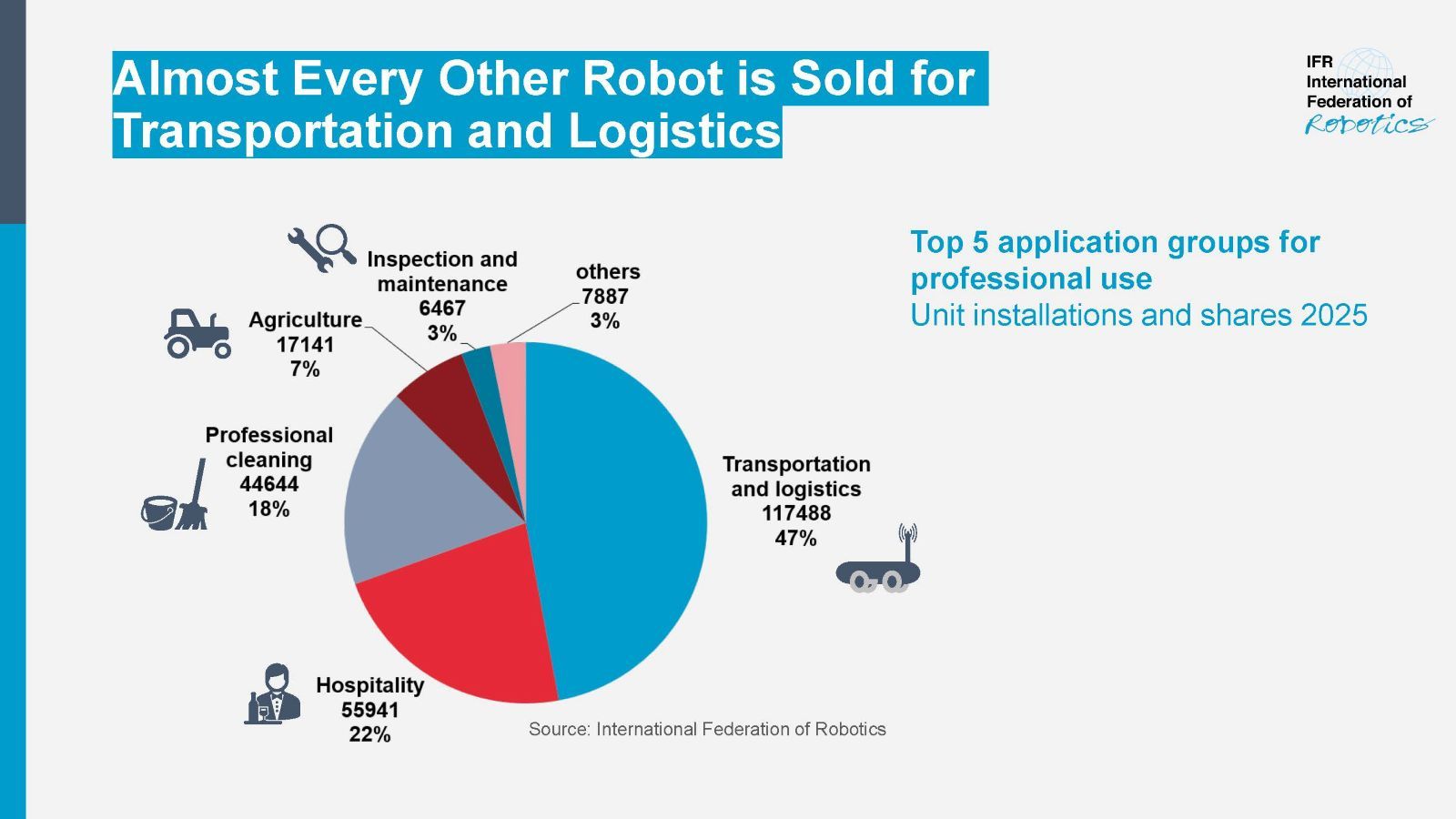
The parts of restroom work that are automated in production are mostly around the toilet, not in it. Robotic floor scrubbers are routine in big retailers: Brain Corp said in 2020 that Sam's Club would add 372 Tennant T7AMR scrubbers, "resulting in a robotic scrubber in every club" in its US chain of nearly 600 stores.21 These are autonomous mobile robots, but Walmart's first ones needed "adult supervision (an associate has to prep the area and map the machine's route)".20 The International Federation of Robotics counted 44,644 professional cleaning robots installed in 2025, from its survey of producers, with "floor cleaning as the main application".25
Sensor systems change when restrooms get cleaned rather than who cleans them. Tork Vision Cleaning puts sensors in dispensers and people counters to "notify cleaners when dispensers require refills and how many users have entered a restroom". Tork says it has "more than 100,000 connected devices" sending "more than 1.3 million messages a day to cleaners". In the same release, the facilities director of a Paris headquarters managed by Sodexo said 1,300 devices "led to up to 90% fewer complaints".22 That's AI assisting cleaners, not replacing any task.
Two older kinds of automation never needed a robot arm. Airport Authority Hong Kong said in April 2020 that an "Intelligent Sterilization Robot" with an ultraviolet light and air sterilizer was "deployed round-the-clock in public toilets and key operating areas", able to "sterilize up to 99.99% of bacteria in its vicinity" in 10 minutes, by its own account.10 And Paris's 435 public sanisettes clean and disinfect the toilet in thirty seconds after each use; even so, the city says its contractor "will intervene, on average, three times a week on each sanitizer" to supply consumables, clean, empty bins and repair parts.24
What the evidence does and doesn't show
Measured against the janitor's core tasks, robots do two in production at some sites: the floors, through autonomous scrubbers, and the toilets and basins themselves, through about a hundred Star X2 robots in Hangzhou's public toilets. Everywhere else, toilet-cleaning robots are pilots, lab results or vendor claims, and the pilots that operators confirm all started in 2026. In every case we found, a person still restocks paper and soap, handles blockages, cleans what the robot can't reach, or checks the result.
None of the operators here has linked a restroom robot to job cuts, and the sources frame the robots as an answer to a shortage of cleaners rather than a surplus. Japan's labour ministry says the job-openings-to-applicants ratio for building cleaning has stayed between about 2.0 and 3.0, and that 57.9% of building-cleaning workers were aged 60 or over in the 2020 census.23 Singapore treats restroom cleaning as its own rung on the cleaning sector's Progressive Wage Model: a full-time outsourced restroom cleaner in an office, school or hospital must earn at least S$2,495 a month in basic wages from July 2026, against S$2,080 for a general cleaner.26 Those are the stated contexts, not measured effects of the robots, and no source in this post has measured what toilet-cleaning robots do to the number of cleaners.
Sources
- O*NET OnLine (O*NET 31.0), Summary Report for 37-2011.00, Janitors and Cleaners, Except Maids and Housekeeping Cleaners (description and tasks; wage and employment data from the Bureau of Labor Statistics, 2025, and its 2025–2035 projections) and Details Report (task importance and core and supplemental ratings), retrieved 2026-10-18.
- Hangzhou Net (Hangzhou Daily Press Group), 从一台样机到1500台订单,只用了三年!数贸会上看杭州机器人如何"长大" (From one prototype to 1,500 orders in three years), September 26, 2026. In Chinese; quotations are our translation.
- Caiwen via 10jqka, 能洗马桶、会烘干,这台清洁机器人不抢人饭碗只给人减负 (It washes toilets and dries them: this cleaning robot lightens workers' load), September 27, 2026. In Chinese; quotations are our translation.
- JDSC, 国内初、フィジカルAI清掃ロボット「Loki」のオフィスビル実証を開始 (Japan's first office-building trial of the physical AI cleaning robot Loki begins; joint release with Nippon Steel Kowa Real Estate), August 24, 2026. In Japanese; quotations are our translation.
- innovatopia, フィジカルAI清掃ロボット「Loki」国内初実証 床を掃く機械から便器に触れる機械へ (Loki's first trial in Japan), August 25, 2026. In Japanese.
- Robotstart, ソフトバンクロボティクス、Lokiのトイレ清掃ロボットを日本初披露 (SoftBank Robotics shows Loki's toilet-cleaning robot in Japan for the first time), July 29, 2026. In Japanese.
- Loki Robotics, company website, retrieved 2026-10-18.
- Business+IT (SB Creative), JR東日本とソフトバンクなど、赤羽駅で駅舎清掃DXの実証実験 (JR East, SoftBank and others trial station-cleaning DX at Akabane Station), October 16, 2026 (secondary source reporting JR East's release of the same day, which we could not open; the publisher belongs to the SoftBank group). In Japanese; quotations are our translation.
- Central Nippon Expressway (NEXCO Central), トイレ清掃の一部を担う「清掃ロボット」を導入します (Introducing a cleaning robot to take on part of restroom cleaning, from July 9, 2021 at Hamamatsu SA), June 30, 2021. In Japanese; quotations are our translation.
- Airport Authority Hong Kong, press release on HKIA's anti-epidemic measures, including the Intelligent Sterilization Robot, April 26, 2020.
- Vertex Ventures Southeast Asia & India, Hivebotics raises US$6 million Series A led by Vertex Ventures Southeast Asia & India, September 4, 2026.
- The Straits Times via Asia News Network, Autonomous cleaning bot to start scrubbing public toilets in early 2024, December 4, 2023.
- Primech AI via Media OutReach (Viet Nam News), Primech AI, a Subsidiary of Primech Holdings, Launches AI-Powered Automated Toilet Cleaning Robot, Hytron, November 7, 2024.
- Primech Holdings via GlobeNewswire (Nasdaq), Primech AI Commences 2-Year Lease Deployment of HYTRON Autonomous Bathroom Cleaning Robot, May 22, 2025.
- Somatic, product and pricing page, retrieved 2026-10-18.
- Popular Science, Bathroom-cleaning bots still have a ways to go, August 22, 2023.
- TechCrunch, This bathroom-cleaning robot is trained in VR to clean up after you, March 4, 2020.
- etnews, "청소부터 보고서까지"…화장실 자율 청소 로봇 눈길 (From cleaning to the report: an autonomous restroom-cleaning robot), June 29, 2026. In Korean.
- Yunfan Jiang et al., BEHAVIOR Robot Suite: Streamlining Real-World Whole-Body Manipulation for Everyday Household Activities, arXiv:2503.05652, first version March 7, 2025 (Table A.X, "clean the toilet").
- Walmart, You'll Never Believe Who's Scrubbing the Floors at Walmart, October 4, 2018.
- Brain Corp, Brain Corp Expands Commercial Relationship with Sam's Club to Power In-Club Autonomous Robots and Connected Data Services, October 2020.
- Tork (Essity), Tork Vision Cleaning achieves milestone, June 27, 2025.
- Ministry of Health, Labour and Welfare, via the Cabinet Secretariat, 省力化投資促進プラン―ビルメンテナンス業― (Labour-saving investment promotion plan: building maintenance), June 13, 2025. In Japanese; quotations are our translation.
- City of Paris, Paris modernizes its 435 public toilets, updated May 22, 2024.
- International Federation of Robotics, Global Sales of Professional Service Robots Surge 24 Percent, September 30, 2026, and its graph of top application groups, 2025 (based on a sample of producers; IFR advises against comparing survey waves).
- Ministry of Manpower, Singapore, Progressive Wage Model for the cleaning sector, retrieved 2026-10-18.